
The peña del castrejón (ojos albos, Avila). Representation of a milenary dance
DOI:
https://doi.org/10.58210/rcdap138Keywords:
Postpalaeolithic rock art - new technologies - interdisciplinary study - chronological frameAbstract
The research project SIGAREP II was centered on rock-art cavities of north face of the Central System as a continuation of SIGAREP I which was centered in the southern face of the mountainous chain. Both projects have been a real experimental laboratory in which we wehre able to test a number of methodologies not only dedicated to rock-art, but the entire environment in order to contextualize those art forms in an área riddled with archaeological sites. Emerging technologies such as 3D laser scanning, photogrammetry, remote sensing or high resolution photography, have been some of the tolos that we used to conduct this study, which was complemented with a complex relational database in order to set up a GIS of the central Iberian Peninsula.
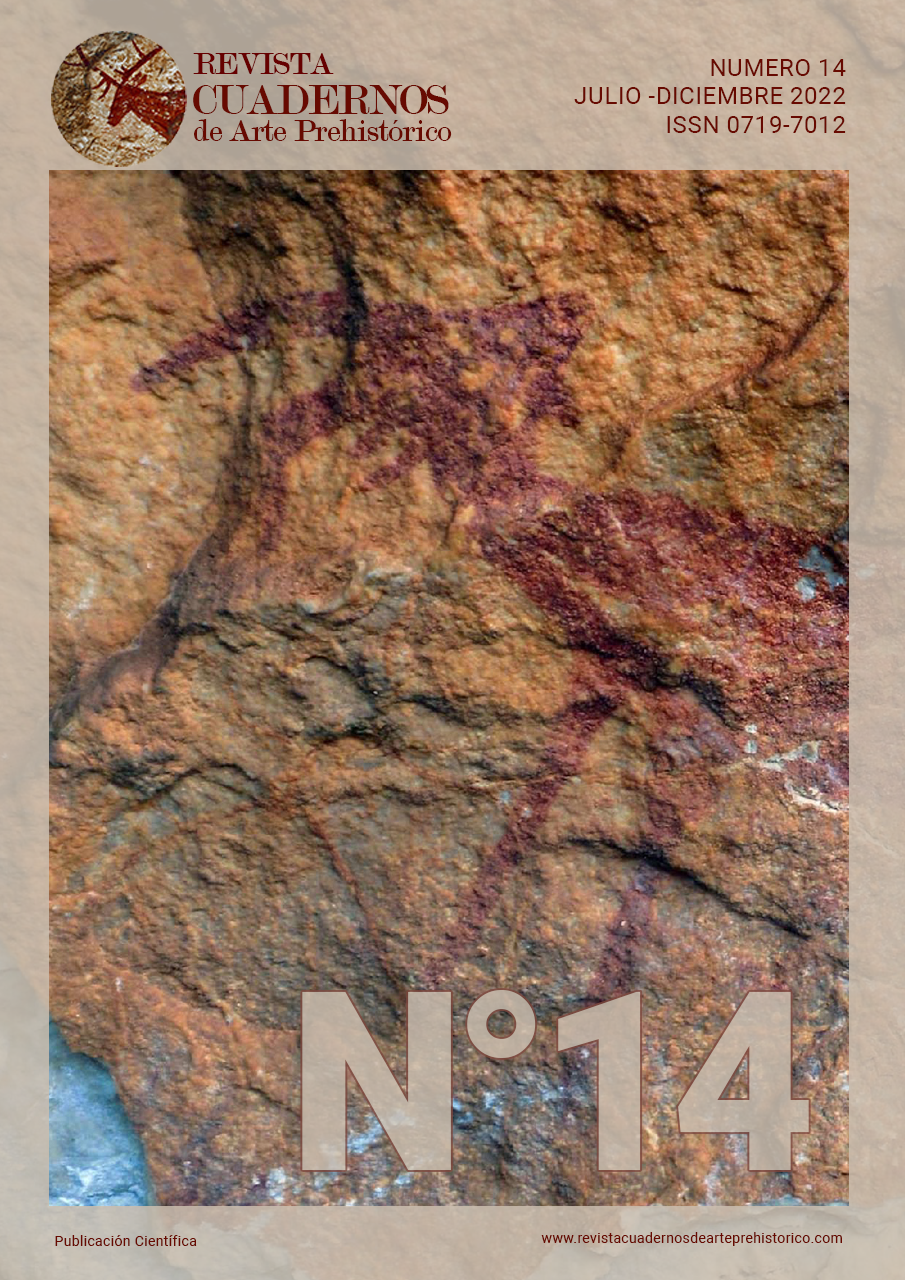
Rock art in the province of Ávila is not too well known, except for some sets such as Ojos Albos or Raso de Candeleda, but in recent years has significantly increased the corpus of stations with schematic art. During the work of documentation in Ojos Albos site, we attracted attention to a completely exposed area close to the previous shelter in which was appreciated a Phi-shaped anthropomorphous. We proceeded to full document this panel and our surprise was that by applying different digital image processing algorithms, we found that the only figure had become a complex scene that was particularly important due to their stylistic characteristics were similar to other places very remote from this área. The scene is formed by a set of 21 human figures with a strong naturalism far from local conventions. Apparently only one is a male and the rest female, associated with three circular ideomorphous with different morphologies. Clearly superimposed on this set is the figure of the discovery which has become three human figures and a circulate sign made of points.
Downloads
Published
Versions
- 2022-12-10 (3)
- 2022-12-06 (2)
- 2022-12-05 (1)
Issue
Section
License
Copyright (c) 2022 Sergio Ripoll, Vicente Bayarri, Luciano J. Municio, José F. Fabián, José Latova, Elena Castillo, Jesús Herrera

This work is licensed under a Creative Commons Attribution 4.0 International License.
Los autores retienen los derechos de autor y otorgan a Revista Inclusiones el derecho de publicación bajo Creative Commons Attribution 4.0 International (CC BY 4.0). Esto permite el uso, distribución y reproducción en cualquier medio, siempre que se otorgue la debida atribución al autor.